
Why we wrote this
Investors have always reached the single-family home through the same doors: own rentals, buy REIT shares, lend on mortgages. All of them depend on rents, cap rates and exit timing. A fifth door, an investor and a family owning a home together under a contract, has grown without an agreed name or an agreed measure, so the structures that share the name cannot be told apart and their operators cannot be compared. The white paper proposes both, then holds EasyDwell’s own record to the measure, missed payments and empty homes included. A record with no bad months is marketing. A record that shows its bad months is evidence.
1The gap: households that can pay but can’t borrow
In 2016 the World Economic Forum published a picture of 2030 under the title “I own nothing, have no privacy, and life has never been better.” A decade on, most of it has arrived: the rented home, the summoned car, the laptop paid monthly and handed back. The thesis of the paper is simple: as long as the sharing economy keeps growing, demand for alternative paths back to ownership grows with it.
The household that would rather own is squeezed from both sides. The typical home costs 6.0 times household income, up from 4.3 in 2003. Mortgage rates have held above 6% into 2026 while roughly 80% of existing loans sit at 6% or lower, so owners do not sell. First-time purchases fell to about 1.1 million in 2024, half the historical average; the median first-time buyer is now 40; the country is short an estimated 1.2 million homes. Many of the households locked out are cash-rich and credit-poor: self-employment, thin credit files, income that does not fit the paperwork. In mid-2026 a 760-credit borrower was quoted 6.70% on a $257,049 loan; below 620 there was no loan at any price. The alternative is renting, with average U.S. rent up roughly 30% in five years, often for as much as the ownership payment the family was refused.
Why this is investable now rather than a curiosity: single-family rental became an institutional allocation after 2012 once its reporting standardized, the LLC-share chassis has been proven at scale, and third-party administration and servicing technology are within reach of emerging managers.
2What structured co-ownership is, and isn’t
A product belongs to the category only if it passes all five tests: owner-occupancy (a primary residence, not an investment unit); real ownership from day one (a recorded interest, not an option); a fixed contractual payment (only tax and insurance can move); a scheduled path to full ownership (for example, 360 months); and defined exit treatment, including the cure period before any removal.
The look-alikes fail: housing co-ops fail the last three tests; fractional vacation ownership fails on occupancy; home equity investments pay nothing until exit and are a bet on prices; rent-to-own leaves the occupant a tenant. Only structured co-ownership passes all five.
3What the investor is paid for
Three things, in order of importance. An occupancy charge, fixed at signing, for use of the share the fund still owns. An equity purchase, also fixed, that buys the fund’s share back over 360 months. And a down payment that returns cash on day one: across the dataset, 53% of what the fund put into each home came back from the resident at placement. Escrow for tax and insurance passes through and is never counted as income.
About 90% of the return is contractual, which is what separates this from the other doors. A REIT’s return moves with cap rates and equity sentiment; a rental portfolio’s with market rents and occupancy; this one moves with whether a family that chose the house, put its savings in it, and holds a recorded interest keeps paying. The fund retains equity that shares in appreciation, and in decline, on any early sale, refinance or buyout, but the payment stream does not wait for an exit. Given the category’s illiquidity and short history, the paper suggests a first allocation sized as a satellite position, low single digits of investable assets.
4One home, one payment
A Duval County, Florida home was placed in August 2026 under the current agreement at a Starting Value of $199,999 with a $10,000 down payment (5%). The payment is $1,940.00 a month: $493.80 escrow, then of the remaining $1,446.20, $527.78 (36%) buys equity and $918.42 (64%) is the occupancy charge. The split never changes, and the arithmetic closes exactly: $10,000 + 359 × $527.78 + a final $525.98 = $199,999.00. A conventional borrower on the same home, 3% down at 6.70%, would pay $1,252 in principal and interest, of which $169, thirteen cents on the dollar, is principal in month one.

The legal shape is simple. Each home sits in its own Florida LLC divided into 1,000 units; the down payment buys the first units at closing, each equity payment buys a fixed number more, and a memorandum of the resident’s interest is recorded. There is no note, no interest and no deficiency. A missed payment triggers written notice and fifteen days to cure. On every default path under the current agreement the resident’s equity is realized, not forfeited, and possession never changes by self-help. The full paper walks the agreement clause by clause (Section 5.2). The homes in the dataset were placed under earlier forms of it; the first current-form placement closed in August 2026.
5Twelve numbers any operator can report
Co-ownership has no reporting standard, so no operator’s results can be compared. The paper proposes one: twelve metrics with exact definitions, all computable from a contract-level data tape.
Report all twelve from a contract-level tape on a stated cutoff; mark anything the tape cannot support as not yet reported rather than estimating it. Definitions and adoption notes are on the Scorecard page.
6The record: 63 homes, 36 months
EasyDwell’s portfolio, reported against that scorecard: 63 homes bought in Florida workforce markets since 2023, 56 placed with resident co-owners or sold, payment history August 2023 to July 2026. Across 678 months in which a resident was in a home, 659 payments were made and 19 missed, a 97.2% collection rate (the tape’s per-home columns add to 677 / 659 / 18, or 97.3%). Median down payment $19,999, 7.8% of contract price. Five residents left over the period, 8.8% a year on the occupied base; the three repossessed homes were re-placed in 3.2, 4.8 and 5.9 months and are current. Fifty of the 63 homes were current at the cutoff; the rest are named, home by home. Assumed seller mortgages cover 87.6% of gross basis at a weighted 4.0%. Median cushion to basis is −2.2%: the pool is carried at contract price, and the layer that absorbs a price decline is the resident’s down payment and accrued equity, not a mark-up.
What the record cannot yet show. There are no independent valuations. Two of the twelve metrics are not reported because the fields are not on the tape, and resident equity accrued is preliminary. The servicing data is unaudited. The fund’s books have been under third-party administration since 31 March 2026; earlier periods were kept by the manager and reconciled to QuickBooks. All of this is stated in the paper rather than smoothed over.
7The test: Florida’s correction, 2024 to 2026
The dataset’s 36 months ran through the weakest housing market of any large state. Florida values peaked in 2024 and fell through 2025; by July 2026 the typical home was worth 1.8% less than a year earlier, three in four ZIP codes had lost value, one listing in four had cut its price, mortgage rates stayed between 6% and 7%, and the average home insurance premium rose 18% in 2025 to $8,292, the highest in the country. The pool’s 22 counties sit 4.4% below their peaks, against a median Florida county 5.0% below.
Over the same months the contracted payments did not change. Collections were 100% until the correction began and never fell below 95.6% in any quarter afterward; 43 homes were bought into that market in 2025 at prices at or near basis; the three repossessed homes were re-filled inside it. In the three hardest-hit counties (Charlotte −22%, Lee −17%, Manatee −13%) the pool holds four homes, and the three placed by the cutoff have paid every month.
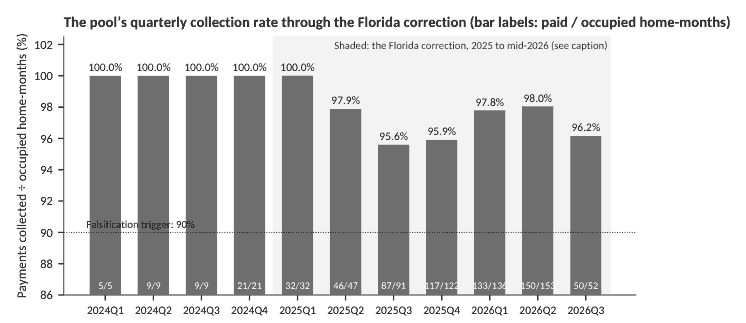
The paper is careful about what that proves. The dip to 95.6% lines up with the steepest part of the decline and the insurance jump, which is where stress travels in this structure: the resident’s ability to pay, not the payment terms. It was a moderate correction, not a crash, and 36 months is not a cycle. The mechanism has been tested by a real downturn, not yet by a severe one.
8Risks, and what would prove this wrong
The paper names each risk and what limits it: non-payment (notice, cure, reinstatement, and a resident with savings at stake); a home-price decline (about 90% of the return is contractual); the in-place financing most homes carry, with due-on-sale clauses and lenders who may accelerate; Florida insurance and tax pass-through, which protects the fund’s cash flow but shocks the resident; illiquidity and multi-year lockups; single-state concentration, 62 of 63 homes; regulatory and litigation exposure; and dependence on the manager.
It then states six events that would disprove the thesis and commits to reporting all six every year:
- Collections below 90% for two consecutive quarters.
- Departures above 10% a year for two years.
- A court treating the agreements as mortgages.
- Lenders accelerating in-place loans at scale.
- Resident equity failing to accrue as scheduled.
- Homes that cannot be re-placed within six months at contract price.
9Where it sits in law
Each home is a Florida LLC; the resident buys units and holds a recorded interest, not a loan. The agreement is drafted as an equity purchase with no note, no interest and no deficiency, which is what keeps it outside Florida’s rule that instruments securing debt are treated as mortgages (Fla. Stat. § 697.01); the paper says plainly that recharacterization is the risk to watch. Federal tax law recognizes shared-equity financing agreements (I.R.C. § 280A(d)(3)), and the Garn–St Germain Act governs the due-on-sale clauses in assumed loans. At the fund level, a vehicle is typically offered under Regulation D to accredited investors with quarterly reporting; independent administration is the market standard for that reporting, and an allocator should ask any operator when it was engaged and which periods it covers.
What to do with this
If the mechanism interests you, the right next reader is an analyst. Three things are worth their time: the scorecard results against the definitions (Section 6, and the contract-level data appendix on request); the legal architecture, clause by clause (Section 5.2); and the Florida county table behind Section 7. If the numbers hold, ask for the data room.
About the author. Raphael Locsin is the founder of EasyDwell and the architect of the structured co-ownership model: the buy box, the underwriting standard and the contract framework every fund property runs on. He maintains the contract-level data tape investors receive in diligence. raphael@easydwell.com · 562-760-8462
Cite as: Locsin, R. (2026). Structured Co-Ownership in Residential Real Estate: Definition, Taxonomy and Performance Standard. EasyDwell Research, Inaugural Edition, Version 2026.09. www.easydwell.com/research
A research publication. Not an offer to sell or a solicitation of an offer to buy any security, and not investment, legal or tax advice. The author and EasyDwell have a financial interest in the adoption of structured co-ownership as an asset class. Figures attributed to EasyDwell are unaudited and reflect a limited operating period. Sources and disclosures are in the white paper.